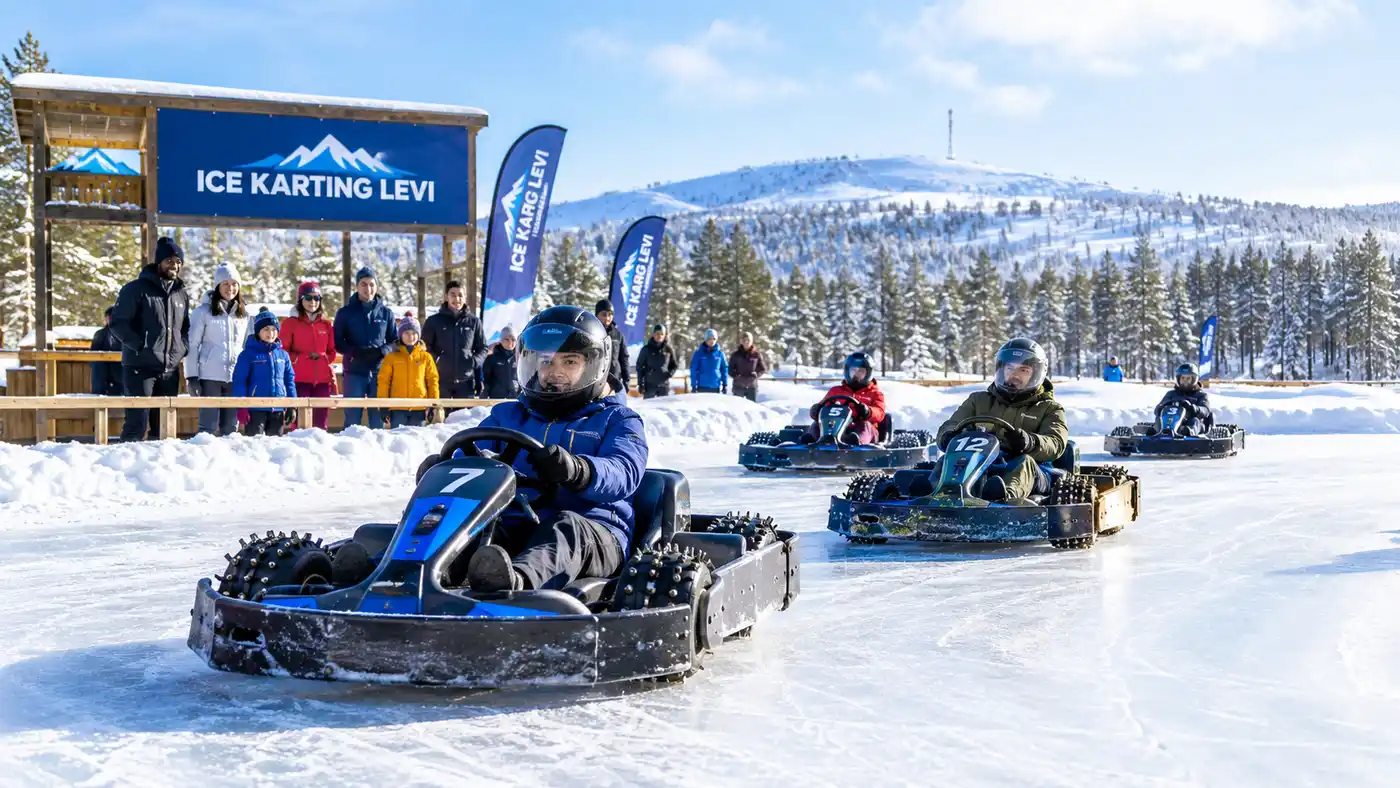
Ice Karting Cars, Studded Tires, and Specifications
My first lap in Finnish Lapland felt ridiculous. You sit two inches above solid lake ice, clutching a frozen vinyl steering wheel, waiting for the rear axle to break loose. It happens before you even clear the pit lane. The ice karting cars used at these sub-arctic tracks look familiar at a glance, but underneath the fiberglass side pods, almost everything has been reworked to survive thirty below zero. Metal gets brittle, oil turns to butter, and standard rubber turns hard as concrete.
Most travelers climb into an ice kart thinking it behaves like the indoor rental karts back home. It does not. An ice kart is light, weirdly loud against the quiet snow, and entirely dependent on hundreds of small tungsten carbide pins biting into the glaze. Understanding the mechanical anatomy of an ice go kart auto - from its stiff chassis to the custom tire spikes - completely changes how you drive on the frozen circuit.
Book your ice karting levi experience:
Behind the Wheel: Anatomy of Modern Ice Karting Cars
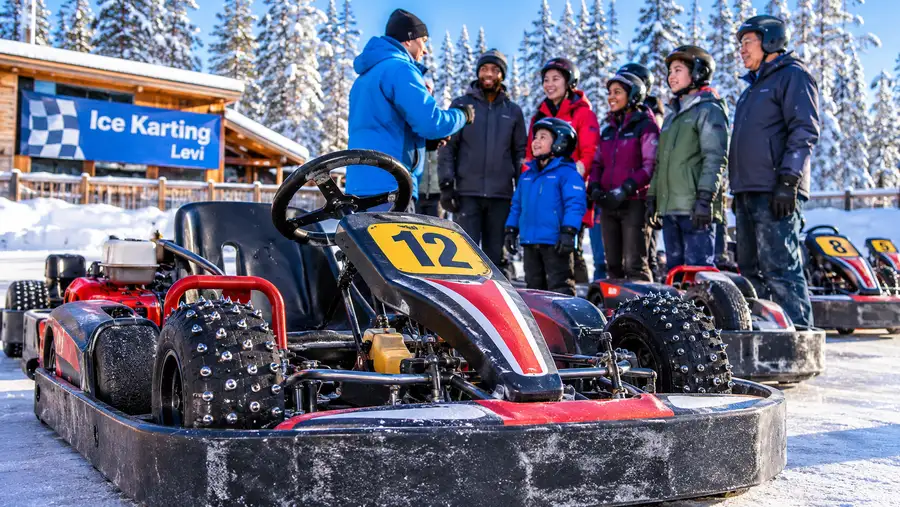
Strip off the plastic bodywork and you will find a reinforced chrome-moly steel tubing frame. Standard indoor chassis are built to flex through high-grip asphalt corners, using that twist to plant the inside tire. On ice, flex works against you. Ice kart racing demands a rigid setup. The mechanics weld additional cross-braces across the main rails so every subtle steering input transfers immediately to the front wheels. If the frame flexes on ice, the studs skip instead of biting, sending you straight into a powder-filled snowbank.
The steering ratio is quick. You get about three-quarters of a turn lock-to-lock, which feels violent when the back end whips out at 50 km/h. There is no power steering, no ABS, and no differential. Both rear wheels sit locked on a single solid 30mm or 40mm steel axle. When you turn, both tires rotate at the exact same speed, which forces the kart into a slide whether you want it to or not.
Cold changes everything about driver ergonomics. Seats are molded wide enough to fit drivers wearing thick Arctic overalls, double socks, and insulated snow boots. You will not find tight fiberglass bucket seats here. The pedals are spaced several centimeters wider than normal, preventing your heavy winter boots from pressing the brake and accelerator at the exact same moment.
Note: Ice karts carry unassisted hydraulic rear disc brakes only. Touching the brake pedal in a drift will lock the solid rear axle instantly, spinning the kart around 180 degrees before you can blink.
Underneath the seat, builders usually bolt a sheet of marine-grade plywood or aluminum. Ice chunks thrown off the front tires smash against the floorpan relentlessly. Without a sturdy skid plate, that flying ice will punch straight through standard thin floor trays, soaking your legs in frozen slush halfway through a session.
The Real Grip: Ice Karting Tires and Metal Studs
Tires are the actual heart of this whole sport. Without specialized ice karting tires, an ice go karting session would just be fifteen minutes of screaming engines and zero forward motion. Standard slick tires spinning on clean lake ice provide almost zero friction. The tracks use custom winter rubber compounds, known locally as ice karting renkaat, which stay soft even when air temperatures dip to minus twenty-five Celsius.
Studding these tires is an art form. Fleet mechanics install between 100 and 160 steel studs into each rear tire and roughly 90 to 120 in the front ones. The front studs give you lateral bite so you can initiate a turn, while the rear studs claw into the surface to push you forward. If you put too many studs on the front, the nose bites too hard and flips the kart sideways into a roll. If you do not put enough on the rear, the tires simply polish the ice into a slick glass sheet without moving.
Track operators adjust the stud protrusion depending on ice conditions. On fresh, hard black ice early in December, short studs measuring 1.5mm to 2mm work best because they punch cleanly into the dense ice sheet. By February, when the track breaks down into granular "sugar snow" and softer ice, mechanics swap to aggressive 2.5mm or 3mm pins to reach the frozen base underneath.
Pro tip: Avoid spinning the rear wheels when pulling out of the pits. Cold tire studs tear out of the rubber carcass if you dump full throttle from a dead stop, ruining your grip for the rest of the run.
Some amateur racing clubs run bolt tyres ice karting setups. Instead of shooting small commercial studs into the tread with an air gun, builders drill holes straight through the tire carcass and run hardened machine bolts from the inside out, securing them with washers and locknuts on the exterior. These homemade go kart ice racing tires look terrifying. They throw massive roosts of shredded ice twenty feet into the air, but commercial rental tracks never use them because they destroy the prepared track surface within three laps.
Engine Setups: From Workhorse Four-Strokes to the Ice Karting CC250
Rental fleets live and die by four-stroke utility motors. Go to any major Nordic winter hub - like the circuits you read about in our Ice Karting Levi breakdown - and you will see Honda GX270 engines mounted on nearly every kart. These 270cc air-cooled powerplants push around 8.5 to 9 horsepower. That sounds modest on paper, but on low-friction ice, nine horsepower is more than enough to spin the tires across the entire straightaway.
Cold weather demands specific carburetor tuning. Jetting must be richened up significantly because dense sub-zero air packs far more oxygen per cubic foot. If an ice kart auto runs standard summer fuel jets, the engine runs lean, overheats its valves, and stalls out in the back turns. Mechanics build custom plastic shrouds around the carburetors to prevent freezing fog and snow dust from choking the air filter.
Then you have dedicated competition machines. In Scandinavia, jääkarting events occasionally feature the legendary ice karting cc250 and ice karting cz 250 two-stroke setups. These machines are a completely different species. Sourced from vintage motocross bikes or dedicated karting engines, a 250cc two-stroke motor screams at 11,000 RPM, pumping out 35 to 45 horsepower.
Driving an ice karting cz 250 on spiked rubber is terrifying. The powerband hits like an explosive charge. While a rental Honda rolls smoothly into power via a centrifugal wet clutch, a CZ 250 requires a hand clutch, quick shifting, and lightning reflexes. One twitch of your right foot breaks all four tires loose simultaneously at 90 km/h.
| Specification | Standard Rental (Honda GX270) | Heavy-Duty Fleet (Honda GX390) | Ice Karting CC250 / CZ 250 | Electric Ice Kart |
|---|---|---|---|---|
| Engine Type | 270cc 4-stroke single | 389cc 4-stroke single | 250cc 2-stroke single | Brushless electric motor |
| Power Output | 8.5 - 9 hp | 11 - 13 hp | 35 - 45 hp | 10 - 15 kW (instant) |
| Top Speed on Ice | 50 - 60 km/h | 65 - 75 km/h | 95 - 115 km/h | 55 - 65 km/h |
| Weight (Dry) | 125 - 135 kg | 140 - 150 kg | 95 - 105 kg | 155 - 170 kg |
| Drive System | Wet clutch, chain drive | Wet clutch, chain drive | Manual gearbox, chain | Direct belt or chain |
| Stud Count per Kart | 400 - 500 studs | 450 - 550 studs | 600 - 800 studs | 400 - 500 studs |
Book your ice karting levi experience:
Chassis Adjustments for Sub-Zero Driving
Dry tarmac karting relies heavily on caster angles and kingpin inclination to lift the inside rear wheel during cornering. If that inside tire does not lift, the locked rear axle binds against the pavement, causing understeer. On ice, you throw those rules out the window. You do not want the inside wheel lifting into the air. You want every single metal stud on both rear tires digging into the frozen lake at all times.
Mechanics flatten the front geometry. Camber is set close to zero degrees, ensuring the widest possible contact patch when the kart is sideways. The rear track width gets narrowed down compared to a summer layout. Bringing the rear wheels closer together makes the back end pivot easier, allowing drivers to initiate controlled slides with quick throttle lifts instead of violent steering jerks.
Cold grease ruins races. Normal wheel bearing grease solidifies into something resembling wax when outdoor temperatures fall past minus fifteen. Teams pack their bearings with synthetic low-temperature aviation grease or thin marine lubricants that stay fluid down to minus forty. If you leave standard high-temp grease in the front hubs, the wheels drag so heavily that the kart will barely roll down the pit lane.
- Front track setting: widened to the maximum limit to provide immediate turn-in grip on slick surfaces.
- Rear axle stiffness: soft hollow steel shafts work better than stiff axles by absorbing heavy ruts.
- Tire pressures: dropped low, usually between 0.7 and 1.0 bar, letting the rubber wrap over ice ridges.
- Drive chains: run slightly looser than summer setups to account for frame contraction in freezing air.
Seat positioning shifts backward. Placing extra body weight directly above the rear axle helps drive the metal pins down into the ice sheet. When light drivers jump into an icekart, crew chiefs often mount ten or fifteen kilos of lead ballast directly onto the rear frame rails. Without that weight, the rear tires simply skim along the frosty surface without gaining traction.
Field Maintenance: How Operators Keep Karts Running at -20°C
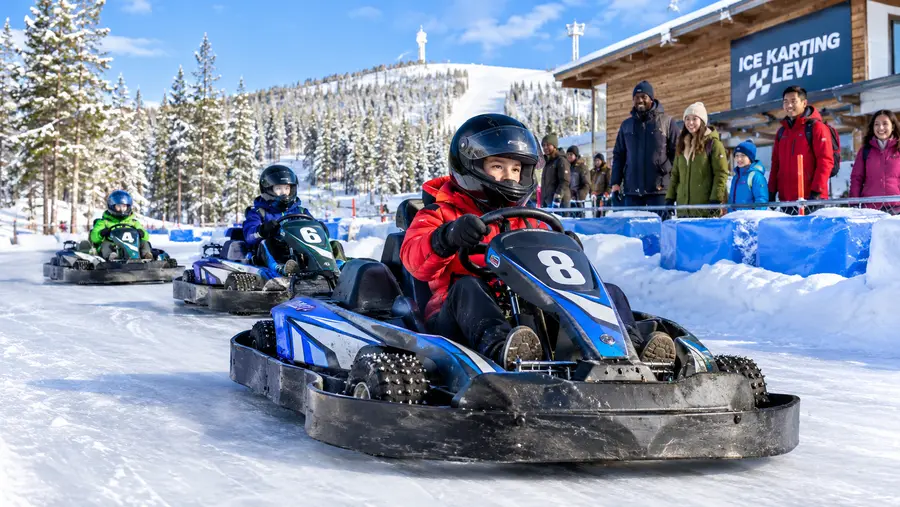
Keeping twenty ice karting autot running day after day across an Arctic winter is pure mechanical warfare. Snow dust penetrates every open crevice. When hot exhaust pipes melt incoming snow, the resulting water trickles down into throttle linkages, brake cables, and starter assemblies. The moment the kart stops moving and sits in the staging lane, that moisture flashes into solid ice, locking the controls solid.
Fleet staff spend half their shifts with heat guns and propane torches. Throttle cables are pre-treated with alcohol-based de-icers rather than standard petroleum oil, which attracts moisture and freezes shut. Air boxes are modified with baffle plates that draw warm air directly off the cylinder cooling fins instead of sucking in freezing ambient air.
Fuel systems need daily babysitting. Condensation forms inside steel fuel tanks when karts move between heated maintenance sheds and freezing outdoor tracks. Mechanics dump pure isopropanol fuel additives into every batch of 98 octane gasoline to bind water droplets before they reach the carburetor float bowl. If water settles in the bottom of that bowl overnight, the ice expands and cracks the cast metal casing wide open.
- Examine tire studs: glance down the tread lines to check if whole sections of metal pins have pulled out.
- Check steering play: grab both tie-rods firmly; cold tie-rod ends can crack after heavy snowbank impacts.
- Inspect brake discs: confirm the steel rotor is free of caked, frozen slush before leaving the pit box.
- Test throttle return: press the gas pedal down by hand and let go to ensure the return spring snaps back instantly.
Chain lubrication gets messy. Traditional sticky summer chain wax collects loose snow and builds up a thick, abrasive paste that chews through sprockets in two days. Mechanics use thin, Teflon-based dry lubricants or spray automatic transmission fluid directly onto the drive chains between driving heats. It flies off everywhere, but it never freezes.
Frequently Asked Questions about ice karting cars
How fast do ice karting cars actually go?
Standard rental karts hit top speeds between 50 and 65 km/h on straight sections. That sounds slow compared to highway driving, but sitting two inches off a frozen lake with zero suspension makes 55 km/h feel incredibly fast. Specialized racing karts with 250cc two-stroke motors can easily surpass 100 km/h on long ice straights.
Do the metal studs ever fly out during a race?
Yes, studs do come loose occasionally, especially if drivers spin their tires aggressively over frozen ruts or bang wheels against other karts. This is why spectator fencing at ice circuits is reinforced with thick safety netting, clear poly barriers, or massive snow berms designed to catch stray metal pins.
Are ice karts harder to drive than regular go-karts?
They require totally different muscle memory. On asphalt, you brake hard in a straight line and smoothly accelerate through the apex. On ice, you must steer with your right foot, deliberately breaking rear traction early and counter-steering while balancing the throttle to maintain forward momentum through the corner.
Quick Reference
- Engine: 270cc 4-stroke (9 hp)
- Tires: Soft winter compound with 100-160 carbide studs
- Top Speed: 50-65 km/h on lake ice
- Brakes: Single rear axle disc only
Book your ice karting levi experience:
Before You Turn the Key
Ice karting is messy, mechanical, and wonderfully physical. You will smell hot motor oil and unburnt exhaust fumes mixing with crisp pine air, and your forearms will burn after three laps of violent counter-steering. These machines are purpose-built survivors of the far north, engineered with bare-knuckle simplicity to handle conditions that would shut down most modern road cars. When the flag drops, forget the brakes, trust the steel studs under your seat, and lean hard into the slide.
Read more about ice karting levi.